Response to ECHA consultation on restriction on the manufacture, placing on the market and use of PFASs (Annex XV report)
We fully support the restriction proposal for the use of PFAS in insulating gases for electrical switchgear.


We represent the Switching Gears for Net Zero Alliance. We are six leading power equipment manufacturers with a commitment to support the EU to set global standards for a cleaner future by phasing out of harmful chemicals used in insulating gases in electrical equipment. We have been relentless in our quest for alternatives to SF6 (an insulating gas with a high global warming potential of over 24,000) using new technologies based on natural-origin gases.
Our consultation response applies to insulating gas in electrical switchgear in all voltage-levels. Although our member companies are active in other sectors and may submit comments on these as well as on other uses of the transmission & distribution sector, our joint comments do not apply to these other uses.
We fully support the restriction proposal for the use of PFAS in insulating gases for electrical switchgear. Multiple European manufacturers are successfully operating switchgear based on natural-origin gases. This technology is tried and tested and has been in operation in the medium and high voltage segments for over 10 years.
PFAS insulating gases for use in electrical switchgear Background
PFAS insulating gases are used as an alternative to SF6 in switchgear. Common PFAS insulating gases for use in switchgear are:
• Fluoronitrile (hereafter referred to as C4-FN) which has a GWP of 2750; (CAS 4532-60-5) and when used in a mix has a GWP < 1000;
• Fluoroketone (hereafter referred to as C5-FK) which has GWP 0.29 (CAS 756-12-7); and
• Some HFOs (hereafter referred to as HFOs) such as HFO1336mzzE, HFO1234yf, HFO1234zeE or HFO1233zd which have a GWP between 1 and 20)
Despite the use of these PFAS as insulating gases, PFAS free alternatives exist (natural-origin gases) and are already available and successfully in use today.
Hazard or exposure to PFAS insulating gases in electrical switchgear
Due to hazardous effects, precautions and handling procedures must be put in place for PFAS insulating gases and skilled manufacturing and service personnel with appropriate training are needed.
Examples of acute toxicity (adverse effects resulting from a single exposure) and. chronic toxicity (adverse effects as a result of long-term exposure) resulting from PFAS insulating gases used in switchgear are well documented. The available researchindicates severe acute toxicities[1],[2], and recent studies have demonstrated the toxicity of Fluoronitrile[3].
Environmental emissions
Leakages of PFAS insulating gases used in switchgear are of great concern. Although PFAS insulating gases such as C5-FK and C4-FN are often touted as having a lower global warming potential, their effects on the climate, ecosystem and human health should not be underestimated.
Insulation gas technologies for electrical switchgear using PFAS will never reach zero direct emissions as the gases themselves will always contribute to the emission level.
For example, when C5-FK escapes or is leaked into the air, it is demonstrated that under the light energy it can be decomposed in air as illustrated in Figure 1[4].
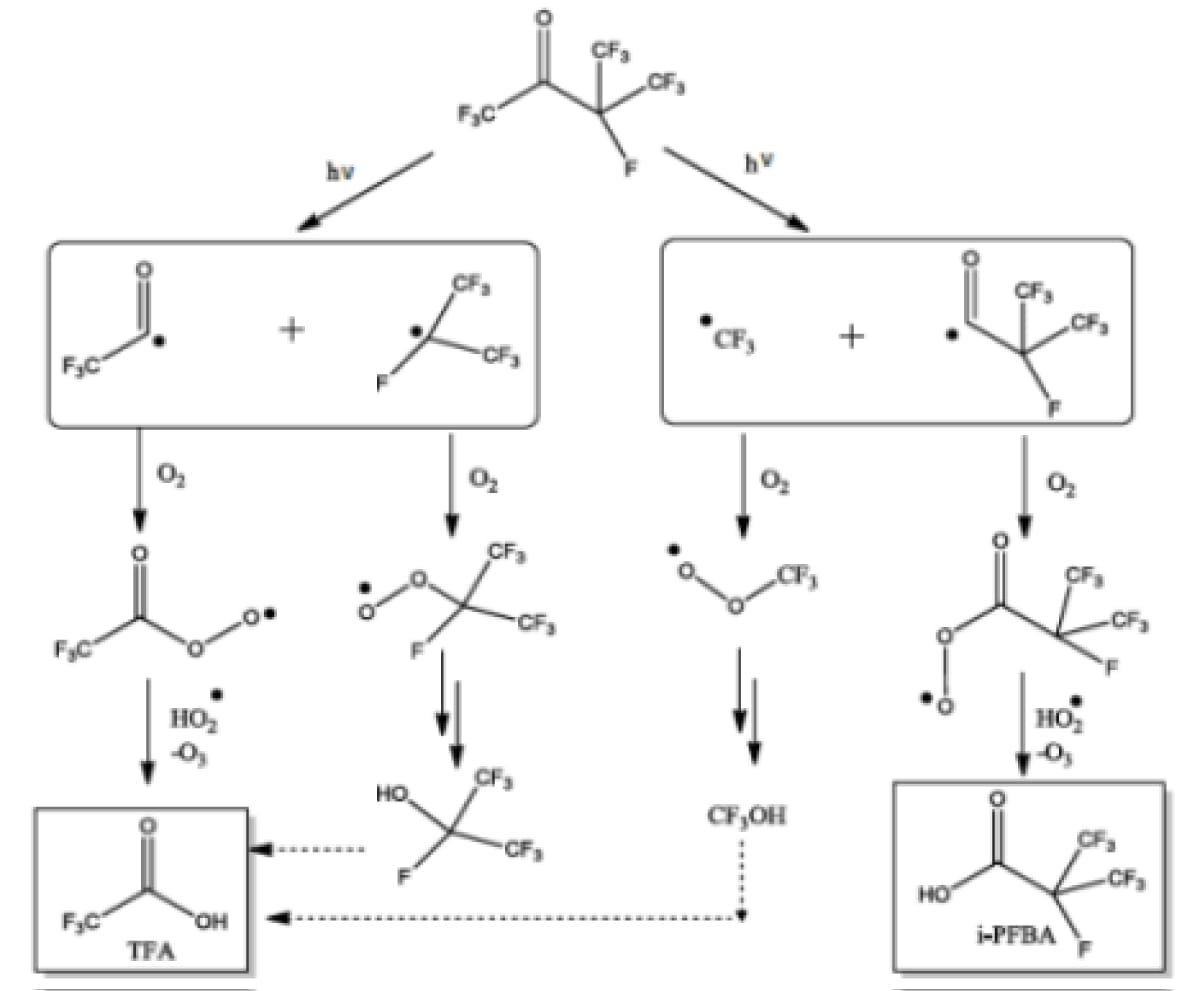
The main element of its degradation is trifluoroacetic acid (TFA) and perfluorocarboxylic acid: i-PFBA. The TFA in particular rapidly separates itself into water droplets and reaches land and oceans via rain, snow and fog. TFA is classified as “harmful to aquatic life with long lasting effects” in its material safety datasheet. In addition, as TFA is a strong acid, it readily forms trifluoroacetate salts with minerals in soils and surface water.
All C5-FK decomposition paths end up in HF (hydrofluoric acid) (LC50: 630ppm) or CF3COOH (Trifluoroacetic acid - TFA) (Inhalation rat LC50: 10 g/m3. The molar yield of TFA for C5-FK is 100%, whereas the molar yield of HFO1336mzzE is up to 20%. However, 2.5 times more HFOs gas is needed with respect to C5-FK to meet the same dielectric withstand at the same temperature range.
As C4-FN, C5-FK, and HFOs are used in mixtures in order to avoid liquefaction at low temperatures, they are impossible to recycle at the end of life or after maintenance. As the destruction process of the mixture is expensive, there is a non negligeable risk that emissions can occur during maintenance or end of life in countries where these gases are not regulated.
Information on alternatives
Background
Natural-origin gas (NOG) technology is based on a mix of nitrogen, oxygen and carbon dioxide, resulting in emissions which are harmless to the environment.
Availability of alternatives
Today, a majority of manufacturers have embraced natural-origin gases. Over 70% of the medium voltage (MV, ≤52 kV) market uses NOG technology, including European champions such as Schneider Electric, Siemens AG, and Nuventura. For high voltage (HV, > 52 kV), 75% of original equipment manufacturers in Europe have this technology available such as Siemens Energy, Hitachi Energy, Trench, Pfiffner, and HSP.
Costs of alternatives
Lifetime costs show natural-origin gas solutions are more cost-effective as there is no need for special gas handling tools or trainings and no costs related to reporting and other requirements.
Furthermore, unlike some PFAS insulating gases, there is no patent on this commodity. NOG technology can be produced by many suppliers and demand for these gases to replace PFAS insulating gases will keep prices low and result in no extra costs to households. Additionally, net costs to society are negative when considering avoided costs to the climate.
Benefits of natural-origin gas alternatives
Only natural-origin gases enable climate neutrality in switchgear. NOG is the technology resulting in the lowest carbon footprint and is non-toxic, non-carcinogenic, non-mutagenic, nor reprotoxic, and generates no toxic metabolites.
Because they are non-toxic, there is no need for specific gas handling tools or personnel trainings, nor are there additional decommissioning and reporting requirements. This helps ensure an efficient maintenance process.
On the other hand, 10,000 tons of Fluoronitrile-mix can be needed annually. Further roll-out of Fluoronitrile in electrical switchgear would create 50+ tons of highly potent climate drivers and PFAS insulating gases leaking into the environment. This outcome can and must be avoided.
Other Socio-Economic Analysis (SEA) issues
Currently, there is no European gas producer of PFAS insulating gases for use in electrical switchgear. In a significant development, following lawsuits across different countries for endangering public health, the (American-based) patent holder of a PFAS insulating gas widely used in switchgear announced the discontinuation of its production by 2025.
This not only highlights industry's readiness to move away from this detrimental technology, but also raises important questions about supply chain vulnerabilities linked to PFAS insulating gases for use in electrical switchgear. If the EU continues to rely on this technology, it risks becoming dependent on critical raw materials sourced primarily from Asian markets. Rather, we should avoid dependencies by moving towards natural-origin gases which are readily produced in Europe. Moreover, natural-origin gases foster price competitiveness by avoiding patent-linked supply chain uncertainties, as multiple suppliers can produce them, thereby resulting in no extra cost to households.
Transitional period/deferred entry into force
These technologies have already been on the market for over 10 years. A derogation period of 12 years is therefore not applicable and a maximum of 5 years is sufficient. For example, our alliance member Nuventura is an SME which was able to develop natural-origin gas technology within a four-year period. In addition to the feasibility of timeframes for original equipment manufacturers to make the switch to NOG technology, multiple suppliers can provide natural-origin gases in Europe (e.g., Linde, Air Liquide), thereby allowing for a smooth transition.
Conclusion
As Europe endeavors to reach climate neutrality by 2050, it is crucial that the electricity system, a cornerstone of this transition, actively contributes to the decarbonization process. However, the presence of PFAS insulating gases in our electrical infrastructure poses a critical obstacle to achieving this goal.
Sources
[1] X. ZHANG et al., "Acute toxicity and health effect of perfluoroisobutyronitrile on mice: a promising substitute gas-insulating medium to SF6", Journal of Environmental Science and Health, Part. A, Toxic/hazardous substances and Environmental Engineering, October 2020
[2] A. CARLES et. al., "Heptafluoroisobutyronitrile (C4F7N), a gas used for insulating and arc quenching in electrical switchgear, is neurotoxic in the mouse brain", Toxicology, Sept. 2022
[3] A. CARLES et. al., "Heptafluoroisobutyronitrile (C4F7N), a gas used for insulating and arc quenching in electrical switchgear, is neurotoxic in the mouse brain", Toxicology, Sept. 2022
[4] D. Jackson et al., 2011, “Atmospheric Degradation of Perfluoro-2-methyl-3-pentanone: Photolysis, Hydrolysis and Hydration”, Environmental Science & Technology, 45 (19), 8030-8036